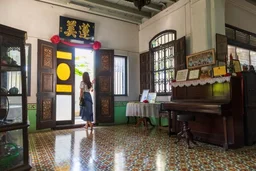
This property stands on Thanon Krabi in the Talat Nuea subdistrict and was built towards the end of King Rama IV’s reign. It is widely believed to be the first example of Sino-Portuguese architecture in the whole of the Phuket province. The distinguishing features of the two-storey house are the ornate front door, decorated with golden Chinese characters and distinctive colored glass windowpanes. There is a small pond located in the airy, open central courtyard area, imported Italian tiles on the floor, an ornate wooden staircase and many household fixtures and decorations from China. In fact, almost everything in the house is imported, a fact made possible Phuket was once a trading route for ships on their way between Penang, Malaysia and Europe.
This property stands on Thanon Krabi in the Talat Nuea subdistrict and was built towards the end of King Rama IV’s reign. It is widely believed to be the first example of Sino-Portuguese architecture in the whole of the Phuket province. The distinguishing features of the two-storey house are the ornate front door, decorated with golden Chinese characters and distinctive colored glass windowpanes. There is a small pond located in the airy, open central courtyard area, imported Italian tiles on the floor, an ornate wooden staircase and many household fixtures and decorations from China. In fact, almost everything in the house is imported, a fact made possible Phuket was once a trading route for ships on their way between Penang, Malaysia and Europe.